
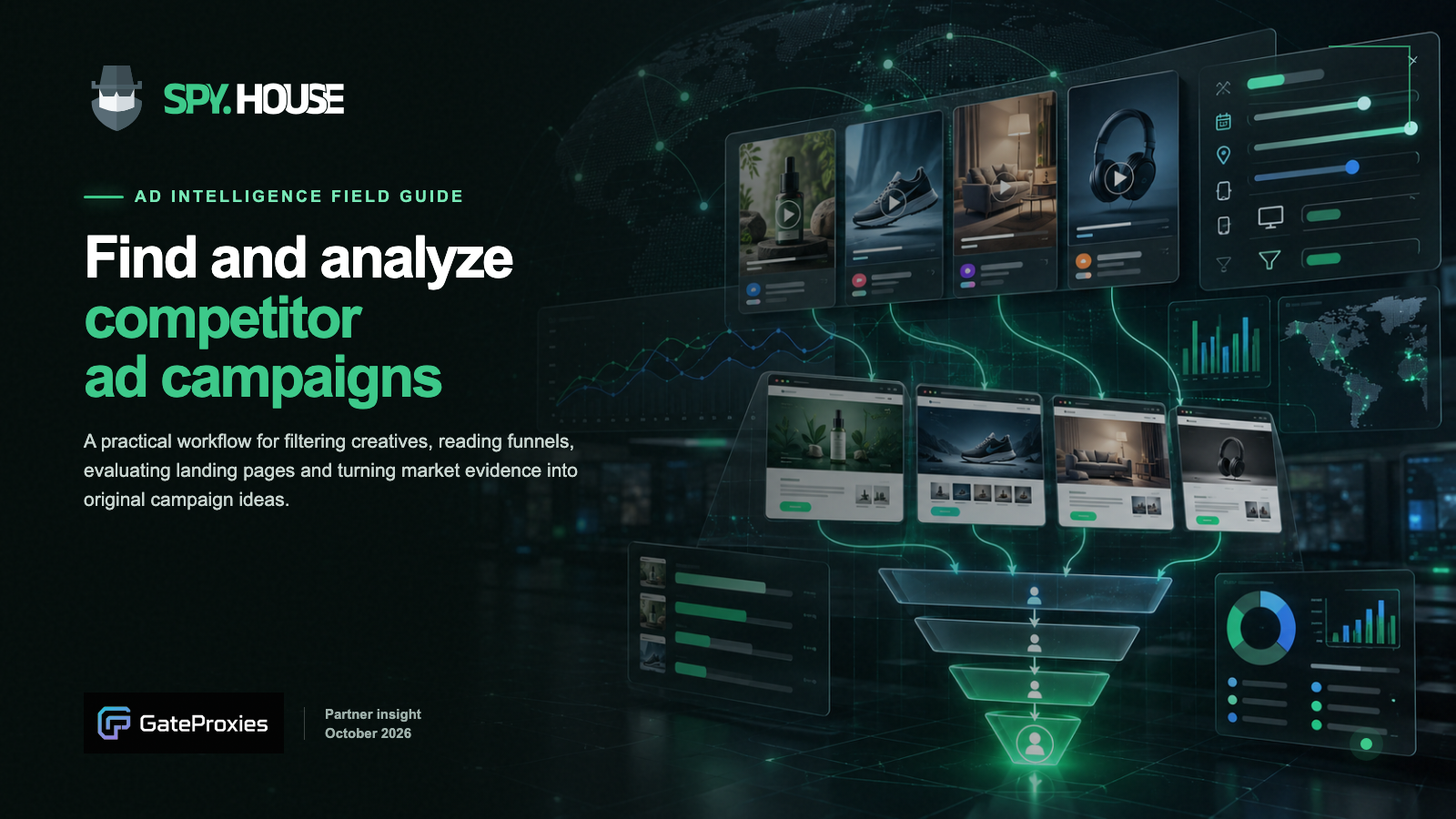
The profitability of an advertising campaign is often determined by how quickly a team can adapt to the market and understand why competing campaigns work. Blind testing consumes budget. Structured competitor research gives media buyers a clearer starting point, while still leaving room to build original creatives, offers, and landing-page experiences.
For performance marketers, Spy.House brings creative research from Facebook, TikTok, Push, and InPage sources into one searchable workflow. Instead of rebuilding every hypothesis from zero, teams can identify patterns that already attract attention, examine how those patterns connect to landing pages, and then develop a distinct campaign for their own audience.
Competitor intelligence is most valuable when it reveals patterns. Use those patterns as evidence, not as permission to copy another advertiser’s creative, code, claims, or protected material.
How the service works
Spy.House continuously monitors and catalogs advertising activity across supported sources. The result is a structured creative database that can reduce the manual work involved in collecting examples, recording campaign details, and comparing offers across markets.
The platform’s research toolkit centers on three capabilities:
- Broad creative archive: promotional material from major advertising sources, organized for faster discovery.
- Advanced filters: narrow results by GEO, language, device, launch period, format, keyword, and other campaign attributes.
- Trend signals: use activity duration and related evidence to distinguish short tests from campaigns that appear consistently.
Used together, these capabilities help a team reduce irrelevant results and focus its analysis on campaigns that match the intended product, market, device, and traffic source.
Key Spy.House capabilities
Global source database
Spy.House states that its database covers more than 185 countries and contains over 12 million creatives. That breadth is useful when a media buyer needs to compare messaging across international markets rather than treating a single country as representative of the whole audience.
Detailed campaign filtering
More than 16 filtering parameters can be combined to remove irrelevant material. A broad keyword search may reveal the category; a second pass using location, language, device, format, and days active can expose the smaller set of examples worth studying.
Funnel and landing-page research
A creative is only the entry point. Spy.House also helps researchers follow the path toward pre-landers and landing pages, where form placement, page structure, offer framing, and conversion hooks become visible. When a landing-page download is available, teams can inspect its technical structure for research. Any reuse should respect copyright, platform rules, and the owner’s terms.
Practical example: researching an e-commerce campaign
Consider a media buyer preparing a campaign for a smart-home gadget. The product is positioned around security and convenience, and the intended market is Nigeria. The research brief is therefore:
- Vertical: e-commerce.
- Product: a smart-home gadget focused on security and convenience.
- Target GEO: Nigeria.
This brief is narrow enough to guide the search but broad enough to discover several creative angles. The goal is to see how active advertisers frame the problem, demonstrate the product, structure the offer, and move prospects toward a purchase.
Choose the source
Start with Facebook for this example, then compare with other sources when relevant.
Define keywords
Begin with “smart camera,” then test related phrases and problem-led terms.
Set the GEO
Select Nigeria so the research reflects the intended market.
Filter by activity
Use days active to separate quick tests from campaigns with sustained visibility.
Read the funnel
Compare creative, copy, pre-lander, landing page, form, and offer continuity.
Build an original angle
Extract the underlying trigger, then create new material for your own brand and audience.
Setting up filters and starting the search
Select Facebook in the source controls and enter a phrase relevant to the offer, such as “smart camera.” Multi-word phrases can improve precision, but they can also hide useful variations, so it is worth repeating the search with synonyms, product features, and problem-led language.
Next, choose Nigeria as the GEO and add a filter for days active. Duration is not proof of profitability, but it is a practical signal: a campaign that remains visible over time may deserve closer inspection than a creative that appeared briefly and disappeared.
If the initial result set is weak, change one variable at a time. This makes it easier to understand whether the keyword, source, format, language, or activity threshold was responsible for the difference.
Analyzing the creative feed and identifying trends
Once the filters are applied, the resulting feed may include video ads, static banners, headlines, body copy, calls to action, and related campaign details. The useful question is not “Which ad should be copied?” It is “Which patterns appear repeatedly, and what buyer concern does each pattern address?”
Look for recurring product demonstrations, hooks, visual pacing, proof elements, objections, urgency devices, and calls to action. Record these observations in a simple research sheet. Patterns that occur across several unrelated advertisers are more useful than an isolated design choice from one campaign.
Analyzing landing pages
A strong creative can still fail when the post-click experience is slow, confusing, or inconsistent with the promise made in the ad. This is why campaign analysis should continue through the pre-lander and final landing page.
Review the page hierarchy, opening claim, product demonstration, trust signals, form placement, offer stack, objections, and mobile experience. Check whether the visual language and message continue naturally from the advertisement. The objective is to understand the conversion logic, not to reproduce another company’s page.
Creative adaptation: turning evidence into an original campaign
Finding a promising source is only the beginning. The next stage is translating the evidence into material designed for your own product, audience, and brand. Direct copying creates legal, reputational, and performance risks.
- Banner blindness: audiences are less likely to respond to creative ideas they have already seen repeatedly.
- Platform and rights risk: copied visual material, claims, page code, or brand assets may violate advertising rules or intellectual-property rights.
- Weak strategic learning: copying preserves surface details but often misses the audience insight that made the original campaign effective.
A stronger approach is reverse engineering. Identify the customer tension, proof mechanism, product demonstration, or narrative structure that creates interest. Then rebuild the campaign with new copy, new art direction, accurate claims, and an experience that belongs to your brand.
Conclusion
Spy.House can turn competitor research from an unstructured browsing session into a repeatable workflow. Its creative archive, campaign filters, and landing-page visibility help teams move from broad market exploration to a focused set of testable ideas.
The advantage does not come from cloning what others have built. It comes from seeing patterns earlier, understanding funnels more clearly, and using that evidence to create a better original campaign.
Start with the partner offer
Gateproxies users can use promo code GETEPROX for 30% off the first Spy.House subscription. Open Spy.House through the partner link, apply the code during checkout, and begin with a tightly defined research brief.